
Why I Made Star and Serpent Solitaire
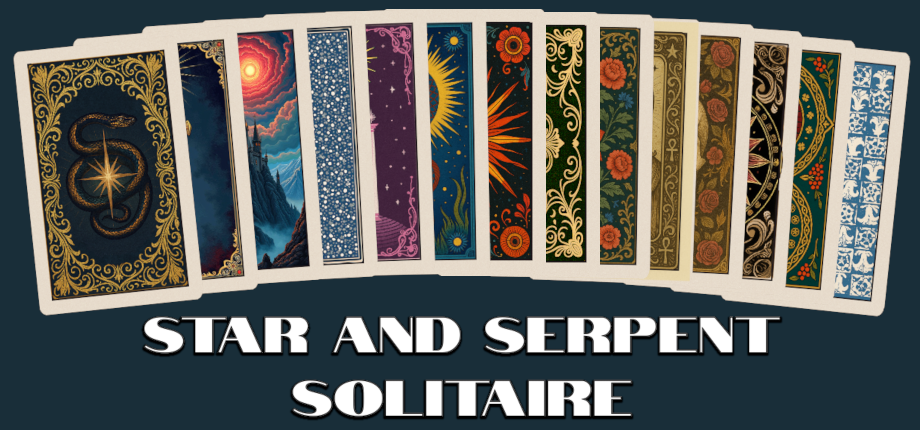
I like solitaire, but I have a complicated relationship with it.
Klondike is one of those designs that is almost aggressively efficient. It is simple, readable, and familiar to almost everyone. You can play it without thinking much, or you can play it with full attention. It fits five minutes and it fits an hour. That is not an accident. It is a very mature design.
At the same time, most solitaire experiences have the same endpoint: you win, you lose, and then you deal again. The game does not really acknowledge the fact that you might do this thousands of times. It treats each hand as disposable.
That is the gap I wanted to address. I wanted a solitaire game that respects long-term play as the primary way it will be consumed.
The core problem I wanted to solve
A lot of solitaire games feel like a vending machine. You pull the lever, you get a hand, you play it out, and then it is gone. If the hand was interesting, that interest was not captured anywhere. If the hand was frustrating, you just reset and hope the next one is better. Over time, this creates a weird emptiness. You can spend tens of hours playing, and the game has nothing to show for it besides a vague memory of streaks.
I did not want Star and Serpent to be disposable in that way.
I wanted repeated play to have continuity, so that the act of playing many hands is not just repetition. It is progression. It is accumulation. It is something you can return to.
Why I changed Klondike as little as possible
Klondike works because its constraints are easy to understand. A change that looks small on paper can easily break that clarity.
My first instinct was actually that adding any new cards would be a mistake. Klondike is tuned to a 52-card deck. It is reasonable to assume that adding four more cards would either ruin solvability or bloat the pacing.
But I still wanted to try one change that would increase depth without changing the identity of the game, and I wanted that change to matter thematically too. That was the inclusion of tarot as the game’s main theme.
I have a longstanding love for tarot imagery and mysticism, and I did not want that layer to be a superficial skin. In tarot’s minor arcana, the Page is an integral part of the court for each suit, representing a distinct role in the suit’s progression. Adding in the Page cards instead of dropping them out to align with Klondike’s regular 52-card play was the cleanest way to align the mechanics with that structure: four extra cards, one per suit, inserted as a new rank. That is it.
In practice, it made the game slightly longer to solve, but not in a way that felt like dead time. It increased the number of intermediate states where you can see what you want to do, but you have to work to create access. It also increased the number of positions where one careless move closes options later. That is the kind of difficulty I wanted: not chaos, not randomness, but pressure on planning.
Why the game is harder, and why I am fine with that
Most digital Klondike implementations are calibrated so that wins are common. That is understandable. A lot of people want a gentle game where they can win regularly.
I wanted something else.
When I play solitaire, I do not want every hand to be a victory lap. I want the win to feel like it was earned. Losses should happen like in regular paper card solitaire. And not because the game is unfair, but because the constraints and hidden information create real friction.
The Page cards push the game in that direction, but the bigger driver is the choice to emphasize the standard three-card deal style. Three-card dealing creates a real access management problem in the waste. The top card is available, and the cards beneath it are blocked until you cycle. That forces planning about timing, and it creates situations where you can see a good line of play but you have to unlock it.
One-card dealing has a very different character. If you can see the table cards and you can cycle through the waste with full access, then the game stops being about access and becomes much more about not making a mistake. That can be enjoyable, but it does not feel like the same game to me.
Thoughtful Mode exists because I do not want one play style to dominate
Even though I prefer the uncertainty and access management of traditional play, I also understand why players want more information. Some people want solitaire to behave more like a puzzle than a gamble.
That is why I added Thoughtful Mode.
In Thoughtful solitaire variant, you can see all the table cards from the start, they are dealt face up. The rules do not change. What changes is how you strategize. It reduces variance and makes the outcome depend more on sequencing and structural decisions. You still have to manage constraints, but you are managing them with clearer information.
This mode is opt-in, and it takes effect on a new deal. I did not want it to become a mid-game cheat that turns uncertainty on and off.
The lack of Undo is a deliberate stance
Undo is a quality-of-life feature that many players expect. I understand why. It makes experimentation comfortable, and it reduces frustration on accidental moves.
I also think it changes the psychological contract of the game.
Without Undo, you commit. You choose a move and accept the consequences. That makes each hand feel more like an attempt rather than a search tree. It also protects the tension created by hidden information and access to playable cards.
I have not ruled out adding Undo completely if enough players strongly want it, but I did not want to start from the assumption that it must exist. I wanted to see what the game feels like when choices have weight. I have not missed it.
The thing I cared about most: what happens after you win
The larger design goal was never just to make Klondike harder. It was to answer the question: “what now?” after you finally win and get that sinking anticlimactic feeling.
My answer was to build a second layer that runs under the solitaire hands. You gain gold, you unlock items and treasures, and you gradually reveal small pieces of story. The point is not to turn solitaire into an RPG. The point is to make the act of playing many hands feel acknowledged by the game.
This is also why the progress in the game game can feel frustratingly slow if you treat it like a checklist to strive for. The progression is intentionally tuned for long-term casual play. If you play 4-8 hands per day, every day, over months, should produce a steady stream of surprises. If you approach it with a completionist mindset, you can force it into grind. That is not the intended rhythm. While you can 100% complete the game by playing it around 50 hours straight I see that as potentially as a harmful mindset. The game is not designed for fast progress. It will become incredibly grindy and destructive when approached from “everything to me now” mindset.
At the same time, I did not want players who only want pure solitaire to be trapped inside meta systems. So most of that layer can be ignored, and parts of it can be turned off in settings.
What I think solitaire is good at
Solitaire is not about mastery in the same way as competitive games. It is not a test of reflex or execution. It is a controlled environment where small decisions accumulate into a result, and where you are constantly negotiating with uncertainty.
That is interesting to me, but only if the game treats repetition as meaningful. If every hand is disposable, then long-term play becomes indistinguishable from idling.
Star and Serpent Solitaire is my attempt to make repeated play feel like a practice with continuity. Klondike as a ritual, not just a pastime.
If that framing resonates, the game will make sense. If it does not, then it will probably feel stricter and slower than the solitaire you are used to, because it is intentionally asking more from the player and offering a longer horizon in return.